How to Support Israel Financially: Donations, Funds, and Responsible Support Models
TL;DR
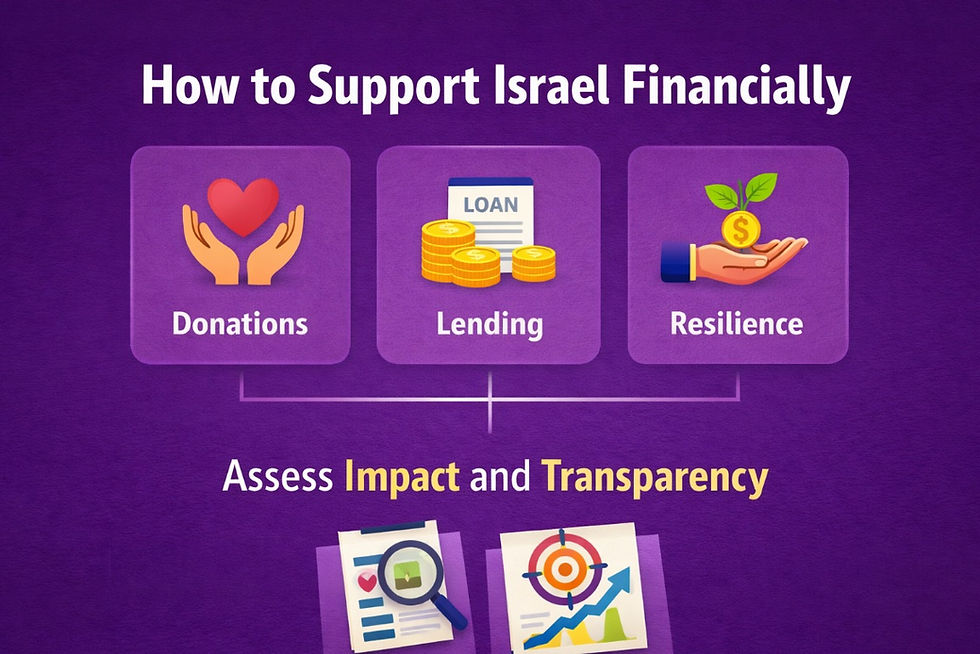
There are several ways to support Israel financially, and they differ in structure, purpose, and long-term impact. Financial support can include direct charitable donations, structured social funds, community lending programs, and resilience-focused financial initiatives. Each model uses money differently, some for immediate relief and others for long-term economic stability. Understanding how each support channel works helps donors choose options that match their goals, time horizon, and risk tolerance. A structured approach leads to more transparent and effective financial support.
What Financial Support for Israel Means
Financial support for Israel can take multiple structured forms beyond simple one-time donations. It includes charitable giving, nonprofit funds, social finance programs, and economic resilience initiatives that deploy capital through different mechanisms.
Some support models focus on immediate needs, such as humanitarian aid or social services, while others focus on longer-term economic stability through structured financial tools. These may include nonprofit loan funds, resilience programs, and blended finance initiatives combined with financial guidance and volunteer professional mentors.
Understanding the differences between these models helps clarify how money is used and what type of impact it is designed to create.
Financial support is best understood as a category of mechanisms, not a single action.
Direct Donations to Israeli Charities
Direct donations are the most widely recognized form of financial support. In this model, funds are given to registered nonprofit organizations that allocate the money toward defined programs, services, or beneficiaries.
Donation-based charities typically focus on:
humanitarian aid
social services
health and welfare programs
education support
crisis response
community assistance
Donations are generally spent rather than recycled. Their strength is speed and immediacy, funds can be deployed quickly to address urgent needs.
However, because donation capital is not repaid, the same funds are not reused. Impact depends on continued fundraising and donor participation.
Structured Funds and Social Support Programs
Some financial support programs operate through structured funds rather than direct spending. These funds pool capital and deploy it through defined program rules and financial mechanisms.
Structured support funds may include:
nonprofit resilience funds
community support funds
social finance programs
targeted economic stability initiatives
These models often include governance frameworks, eligibility criteria, and defined impact measurement approaches. Capital may be allocated through grants, guarantees, or affordable lending depending on program design.
Structured funds are typically built for transparency and repeatability rather than one-time distribution.
Community Lending and Nonprofit Loan Funds
Another financial support model includes nonprofit and community lending programs. In these programs, contributed capital supports affordable loan activity rather than direct grants.
Funds are deployed as loans under social or fair terms. As borrowers repay, capital returns to the fund and is reused to support additional participants. This creates a recycling impact model.
Community lending programs are often used to support:
household stability
essential expenses
mobility and employment needs
financial recovery
economic resilience
This model turns financial support into a reusable stability tool rather than a one-time expenditure.
Donations vs Structured Financial Support Models
Different support models use capital in different ways. Comparing them helps donors understand how their contribution functions inside the program.
Comparison - Direct Donations vs Structured Support Models
Dimension | Direct Donations | Structured Support Models |
Capital use | Spent once | Program deployed |
Recycling | No | Often yes |
Time horizon | Immediate | Medium–long term |
Mechanism | Grants | Funds / lending / guarantees |
Scale potential | Donation dependent | Program scalable |
Both models play valid roles - but they produce impact through different financial mechanics.
Best Ways to Support Israel Financially - Decision Framework
Choosing how to support financially depends on donor goals and preferences. A structured decision framework can help clarify options.
Consider:
Time horizon - Is the goal immediate relief or long-term resilience? Capital reuse preference - Should funds be recycled or spent once? Risk tolerance - Is structured finance acceptable, or only direct charity? Impact measurement - Is outcome reporting important? Program structure - Is governance transparency required?
Different support channels align with different priorities.
How to Evaluate a Trusted Israeli Charity or Financial Support Program
Before providing financial support, whether through donations, funds, or structured programs, it is important to evaluate the organization and the mechanism being used. A structured review helps ensure transparency, accountability, and alignment with donor intent.
Key evaluation criteria include:
Registration and legal status - The organization should be properly registered and compliant with nonprofit or regulatory requirements.
Clarity of financial model - It should clearly explain how funds are used - whether for grants, services, lending, or blended structures.
Use-of-funds transparency - Look for public reporting, audited statements, or program breakdowns.
Governance structure - Credible organizations disclose leadership, oversight, and decision frameworks.
Impact measurement - Strong programs define how outcomes are tracked, not only how money is spent.
Program focus - The support mechanism should match the stated mission and target population.
Evaluation improves decision quality and reduces the risk of misaligned giving.
Common Mistakes to Avoid When Providing Financial Support
Financial support decisions are often made quickly, especially during periods of heightened attention or urgency. However, several common mistakes can reduce effectiveness or transparency.
Choosing based only on emotion - Urgency messaging should not replace program understanding.
Not reviewing the financial mechanism - Donors often check mission statements but not capital structure.
Ignoring reporting transparency - Lack of reporting is a warning signal.
Assuming all nonprofits operate the same way - Support mechanisms vary widely.
Overlooking program sustainability — Some models produce repeatable impact, others are one-time only.
A structured review approach helps avoid these pitfalls.
Types of Financial Support Channels - Quick Comparison
Different channels operate through different financial mechanisms and impact timelines.
Comparison - Major Financial Support Channels
Support Channel | How It Works | Typical Impact Horizon |
Direct charity donation | Funds spent on programs | Immediate |
Nonprofit support fund | Capital pooled and allocated | Medium-term |
Community lending fund | Loans deployed and repaid | Long-term |
Resilience finance program | Structured financial tools | Long-term |
This comparison helps clarify how capital behaves after contribution.
FAQs - Financial Support and Donation Models
What is the best way to support Israel financially?
The best method depends on the donor’s goals. Direct donations support immediate needs, while structured funds and lending programs support longer-term economic resilience. Each model produces impact through a different financial mechanism.
Are donations the only way to help Israel financially?
No. Financial support can also be provided through structured funds, social finance programs, and community lending initiatives. These models may reuse capital and create longer-term impact.
What is impact-based financial support?
Impact-based financial support refers to programs where capital is deployed through structured mechanisms, such as funds or lending, designed to create measurable social or economic outcomes over time.
How can I verify an Israeli charity?
You can verify a charity by checking its legal registration, governance disclosures, financial reports, and transparency statements. Credible organizations publish information about their leadership, funding structure, and program use of funds.
Is donating better than structured financial support?
Neither is universally better, they serve different purposes. Donations provide immediate relief, while structured financial support models often create longer-term, repeatable impact. The right choice depends on donor priorities.
Can financial support create long-term impact?
Yes. When financial support is deployed through structured funds, lending programs, or resilience finance models, capital can be reused and scaled. This allows impact to extend beyond a single funding cycle.
What should donors look for in financial transparency?
Donors should look for clear reporting, governance disclosure, program structure explanations, and outcome measurement, not only mission statements.
Key Takeaways
Financially supporting Israel can be done through multiple structured channels, including direct donations, nonprofit funds, community lending programs, and resilience-focused financial initiatives. Each model uses capital differently and produces impact on a different timeline. Understanding the financial mechanism behind each support channel allows donors to make more informed, responsible decisions. Structured evaluation and transparency review are essential parts of effective financial support.


Comments